The Name Game: A Strategic Framework for Choosing a B2B Brand Name

Olivia Shen • April 24, 2026

From Confusion to Clarity: A Unified Brand System

In the world of high-stakes B2B industries, a brand name is often the first "handshake" a potential client has with your company. Yet, many organizations treat naming as an afterthought or a subjective beauty contest.


Choosing a name isn't just about what sounds "cool" in a boardroom; it is a strategic decision that affects your SEO, your market positioning, and your long-term scalability.


Here is how to navigate the naming process with precision.
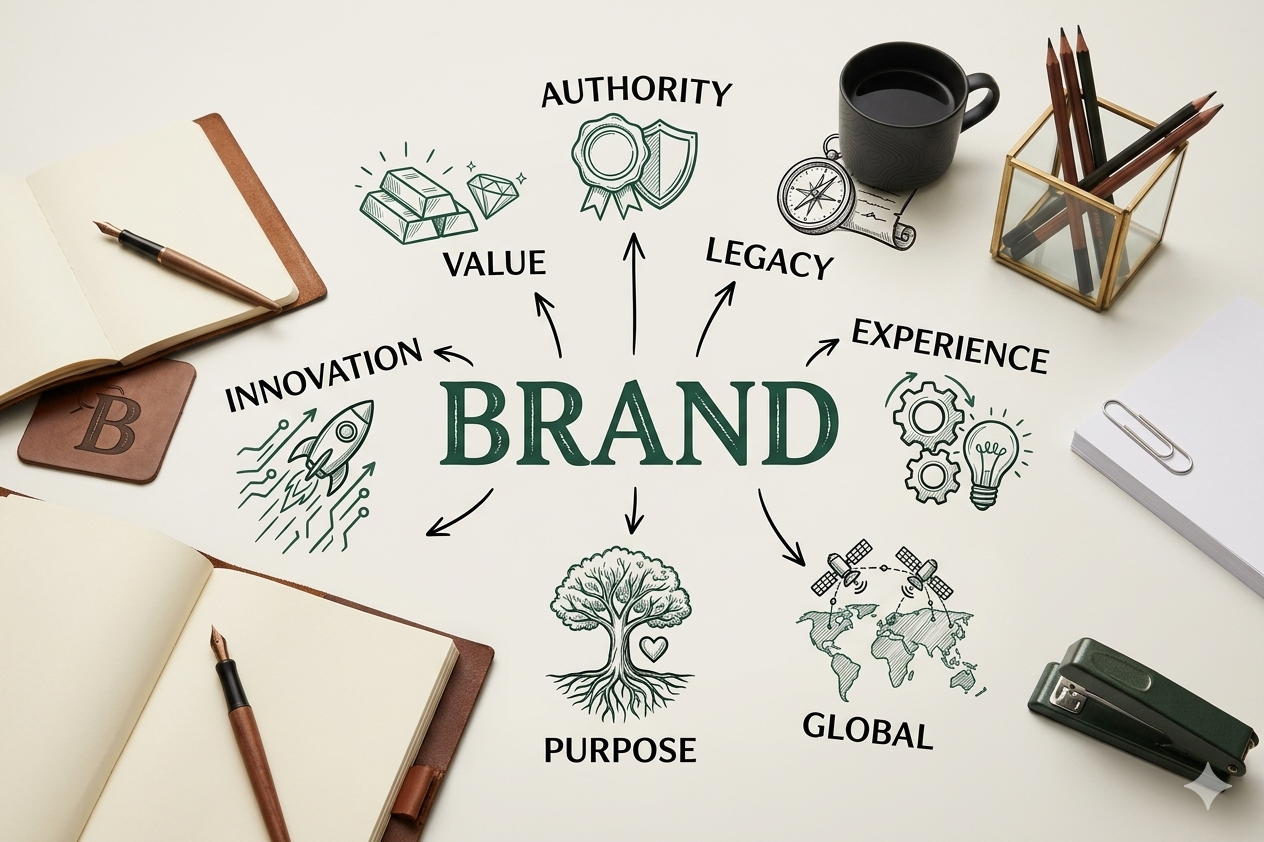
Naming isn't decoration

it’s structural integrity for your business

At Marble Mountains Media, we don’t just "do graphics."

When a client comes to us with a project, we aren't just looking for a color palette that pops or a logo that looks modern.

We are looking for the structural integrity of their future. We don’t just design assets; we build Trust Systems

1. Define the Purpose: Functional vs. Evocative

Before brainstorming, you must decide what "job" the name needs to do.

  • Functional/Descriptive Names: These tell the customer exactly what you do (e.g., "General Motors" or "Arctic Transport Services").
  • Pros: Low barrier to understanding; immediate SEO relevance for specific keywords.
  • Cons: Hard to trademark; difficult to expand into new product categories later.
  • Evocative/Abstract Names: These suggest a feeling, a trait, or a metaphor (e.g., "Apple" for simplicity, "Nike" for victory).
  • Pros: High memorability; easier to trademark; creates a "premium" feel.
  • Cons: Requires more marketing spend initially to explain what the company actually does.


2. The "3-Pillar" Test

When evaluating a name, run it through these three filters:

  1. Distinctiveness: Does it stand out in a sea of competitors? If everyone in your sector uses the word "Tech" or "Global," avoid them.

  2. Accessibility: Is it easy to spell and pronounce? If a procurement officer can't type it into a search bar after hearing it once, you've lost the lead.

  3. Future-Proofing: Does the name lock you into a specific geography or a single technology that might become obsolete in five years?

3. The Architecture Audit


A name does not exist in a vacuum. You must decide how it fits into your Brand Architecture. Are you building a House of Brands (where every product has a unique name, like Procter & Gamble) or a Branded House (where every product shares the master name, like FedEx)?


For most B2B firms, the Branded House is superior because it allows every marketing dollar spent on one product to build "equity" for the entire company.


Case Study: Tuning the ARKTOS Identity

We recently applied this framework to ARKTOS Developments Ltd., a leader in Arctic mobility and disaster response. The project highlights the difference between having a "good name" and a "good brand system."


The Challenge

The client had a powerful, evocative name (ARKTOS, derived from the Greek for "bear" and associated with the North). However, the brand was fragmented:


  • Legal Name: ARKTOS Developments Ltd. (Sounds like a real estate firm).
  • Product Name: ARKTOS Craft (Functional, but separate).
  • Digital Presence: A mix of legacy terminology that confused search engines.


The Strategic Decision

We utilized the Branded House model to simplify their identity.

  1. Elevate the Master Brand: We moved "Developments Ltd." to the legal background and positioned ARKTOS as the hero name. It is evocative, rugged, and premium.
  2. Standardize Product Naming: Instead of creating new, unrelated names for future tech, we recommended a "Master Brand + Descriptor" approach (e.g., ARKTOS Craft, ARKTOS One).
  3. SEO Alignment: By focusing on the word "ARKTOS" across all platforms, we ensured that the company owns the search results for that specific "entity," rather than competing against real estate developers for the word "Developments."

The Takeaway

A great name is a vessel for your company's reputation. By choosing an evocative master brand and sticking to a disciplined architecture, you ensure that your brand is not just a name on a contract, but a searchable, scalable asset.

Are you struggling to decide between a descriptive name or an evocative one for your next product launch?


Is your marketing truly reflecting your vision, or is there a gap between your goals and your current results?


Connect with Marble Mountains Media and let’s put the power of modern marketing to work for your mission. As a start, we offer Free Marketing Audit to find the most effective marketing strategies for your private health practice.


Book Free Audit
By Star Meng May 9, 2026
Let's be honest: Managing a large sales team of financial advisors is a lot like herding high-achieving, hyper-focused cats. You've got talent, you've got leads, and you've got a massive market to dominate. But behind the scenes? It's often a mess of spreadsheets, sticky notes, and "I think I replied to that email" guesses. If your team is currently juggling prospects across personal LinkedIn accounts, Outlook folders, and buried SMS threads, you aren't just losing your mind, you're losing money. In fact, advisors without automated systems spend an average of 12 to 15 hours per week on manual onboarding and admin tasks. That is time you could be using to close high-net-worth clients or, you know, actually enjoying your weekend. At Marble Mountains Media , we've seen it all. We know that for a large financial advisory firm, "good enough" isn't good enough. You need a unified system that turns chaos into a compliant, lead-converting machine. Here is why your team needs to upgrade to a unified CRM NOW . 1. Stop the "Lead Leak" with a Unified Platform In a large team, leads often vanish into the "black hole" of disjointed systems. A referral comes in via a partner's email, a prospect dms the firm on Instagram, and another calls the office after hours. If these aren't hitting ONE central hub, they're as good as gone. A unified CRM is your single source of truth. It tracks every lead, every call, and every communication in one place. No more asking, "Who spoke to Mr. Miller last?" or "Did we follow up on that $2M portfolio lead?" When your entire team operates out of one dashboard, you eliminate the cracks. You get 100% visibility into your sales pipeline, allowing you to see exactly where prospects are stalling and who on your team is hitting their KPIs. It's not just about organization; it's about HYPERLOCAL dominance. When you respond faster and more accurately than the boutique firm down the street, you win. 2. Automation: The 15-Hour-a-Week Time Machine If your advisors are manually sending "Just checking in" emails or playing phone tag to book a discovery call, they are overqualified for the work they're doing. Modern CRM automation handles the heavy lifting: Nurture Sequences: Automatically send high-value content to prospects who aren't ready to commit yet. Appointment Booking: Let clients book directly into your calendar with automated reminders (reducing no-shows by up to 40%!). Compliance Workflows: Ensure every interaction is logged and timestamped automatically to meet SEC and DOL requirements. By automating these workflows, you don't just save time, you reduce human error. In the financial world, a missed compliance step isn't just a mistake; it's a liability. We build these systems to ensure your team stays compliant while they stay busy. 3. The Secret Weapon: 'Missed Call Text Back' We've all been there. You're in a high-stakes meeting, your phone buzzes with a new prospect, and by the time you call them back 20 minutes later, they've already called your competitor. In the financial industry, speed to lead is everything. That's why our CRM includes the Missed Call Text Back feature. The moment a call goes unanswered, the system sends an immediate, professional text: "Hi, this is [Advisor Name] from [Firm Name]. Sorry I missed your call! How can I help you today?" This tiny piece of automation does two things: It stops the prospect from calling the next advisor on Google. It opens a text-based conversation: which, let's be real, most people prefer anyway. For a busy sales team, this feature alone can recover thousands in potential commissions every single month. It's about being present even when you're occupied. 4. Multi-Channel Mastery (SMS, Email, Social) Your clients are everywhere. They're checking their email at 8 AM, scrolling LinkedIn at lunch, and texting their family at 6 PM. If your team is forced to jump between five different apps to stay in touch, things will fall through the cracks. A unified CRM pulls SMS, Email, Facebook Messenger, and LinkedIn into one Unified Inbox . This allows your advisors to scale the "personal touch" without the manual labor. You can see the entire history of a relationship: from the first Facebook ad click to the last signed contract: in one scrolling timeline. It makes every conversation feel personal because your team actually knows the history of the client, regardless of which channel they used. 5. Scaling the Personal Touch with AI You might worry that "automation" means "robotic." In reality, it's the opposite. By automating the boring stuff, your advisors have more mental energy to be human. Our AI-integrated websites and CRMs allow you to provide personalized experiences for every visitor. Imagine a website that recognizes a returning lead and displays a custom message from their specific advisor. Or a CRM that pings an advisor to send a "Happy Anniversary" text to a client's portfolio milestone. This is how high-performance teams scale. You don't need more people; you need better systems. You need to leverage technology to do the remembering for you. 6. Compliance is Non-Negotiable Let's talk about the elephant in the room: Regulations. With SEC marketing rules and state-level requirements constantly shifting, you cannot afford to have client data scattered across personal devices. A unified CRM creates an automatic audit trail . Every email, every call note, and every timestamped interaction is stored securely. If an auditor knocks, you don't need to scramble; you just need to hit "Export." At Marble Mountains Media, we don't just "hand over" a CRM. We implement it specifically for high-performance teams, ensuring that your data migration is clean, your team is trained, and your compliance boxes are checked from day one. Ready to Turn Chaos into Growth? Stop letting your leads slip through the cracks. Your team is too good to be held back by outdated tech and manual processes. It's time to dominate your local market with a system that works as hard as you do. Here is your next step: We want to help you see exactly where your current setup is failing you. We offer a FREE 73-point Marketing Effectiveness Audit with no obligation. We'll dive deep into your current digital presence, lead flow, and CRM processes to show you exactly how to reach that next level of ROI. CLAIM YOUR AUDIT NOW.
By Chi Le April 24, 2026
More Than Just a Pretty Logo: How Our Branding Process Builds Trust and ROI
By Chi Le April 24, 2026
The Zero-Click Reality: Why AEO is the New SEO for Healthcare and Tech in 2026
By Chi Le April 14, 2026
Why AI Search Will Change the Way Your Clinic Gets Found in 2026
By Olivia Shen February 5, 2026
Discover key insights from the San Francisco Small Business Expo with Marble Mountains Media, where business connections, AI, and emerging technologies are shaping the future of small business growth.
By Olivia Shen January 8, 2026
Innovation Meets Art: Our Journey to the Googleplex
Street scene with power lines and small buildings, people walking; person in red coat and colorful hat in foreground.
By Chi Le December 27, 2025
Visit to Clinic in Tanzania highlighted dedication to women’s health despite limited resources, reinforcing Marble Mountains Media’s belief in ethical medical marketing
By Chi Le April 4, 2025
A Different Kind of Entrepreneurship: Lessons from Marble Mountains Media business trip in Singida, Tanzania
By Chi Le January 25, 2025
Thrive in a local community that you build and connect
By Chi Le October 1, 2024
Thrive in your local community